Aluminum is the metal that most often sends MIG owners back to the manual. The machine that runs steel wire beautifully may struggle to push soft aluminum wire through its gun cable, and the gas that works for steel is the wrong one for aluminum. This guide answers the question with what Miller Electric publishes in its aluminum MIG resources: which equipment changes are needed, why input power matters, which filler wires are common for home and farm work, and how much cleaning aluminum demands. It then turns those points into a checklist you can apply to an exact multiprocess listing. This is buyer and orientation information, not an operating procedure: read the owner’s manual of the exact machine, follow ANSI Z49.1 and get hands-on instruction before striking an arc.
Can a MIG welder weld aluminum? The short answer
Short answer Yes, a MIG welder can weld aluminum when it is set up for it: Miller recommends a spool gun to feed the soft aluminum wire, pure argon shielding gas instead of the argon/CO2 mix used for steel, and an aluminum filler wire such as 4043 or 5356. Miller also recommends a machine that can run on 230V input, because 115V welders generally lack the power to overcome aluminum’s thermal conductivity and oxide layer.
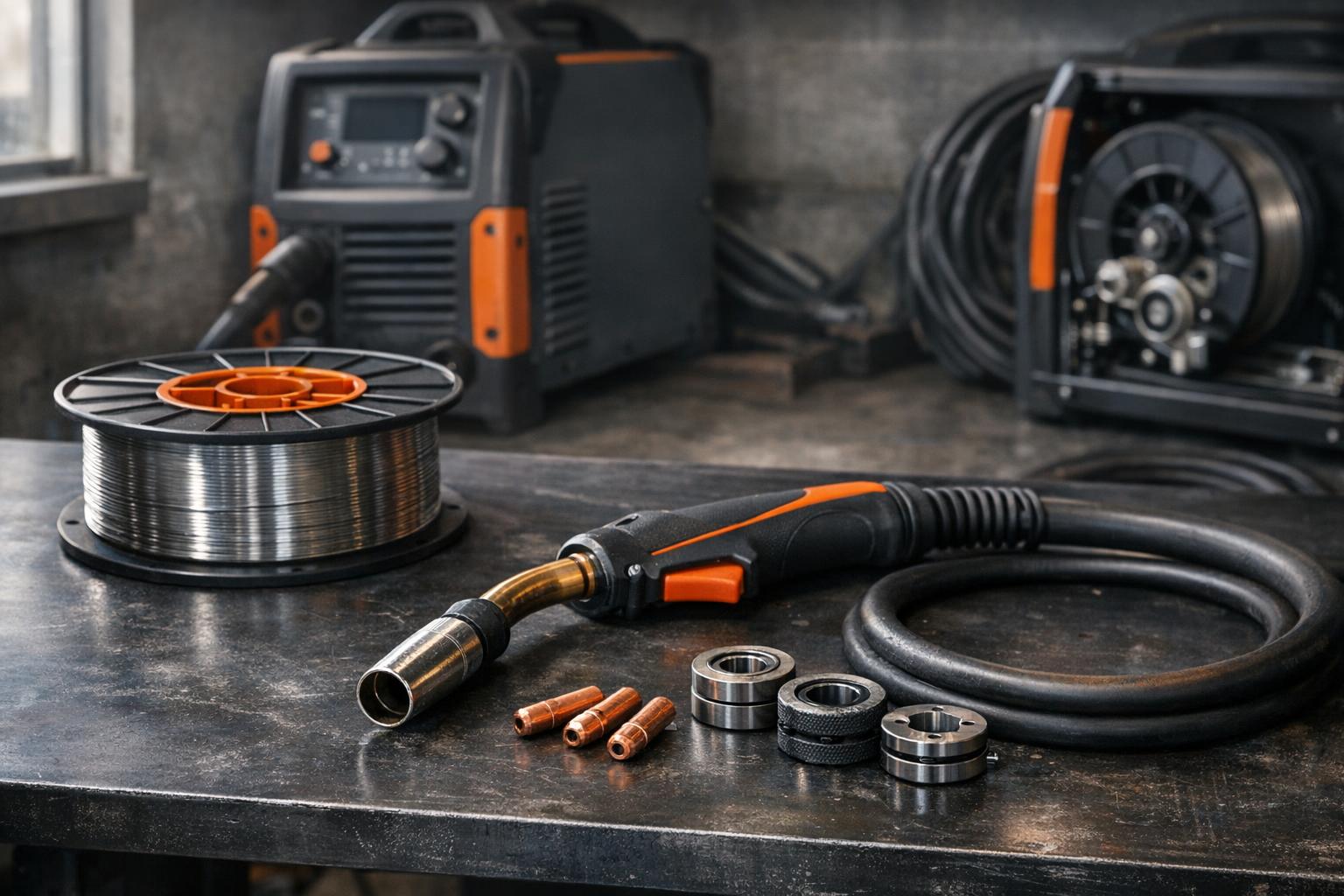
Miller’s explanation of the core problem is mechanical. A MIG machine usually houses the wire spool inside the case and pushes the wire through the gun cable; that “works well for steel but poses a challenge for softer aluminum wire which can sometimes bind, especially when being pushed through a long cable draped over obstacles.” A spool gun puts a small spool on the gun itself, so the feed path is short and straight.
- Feed: spool gun matched to the welder model (Miller).
- Gas: pure argon, not the argon/CO2 mix used for steel (Miller).
- Filler: 4043 for most DIY work; 5356 when a stronger weld or better corrosion resistance is needed (Miller).
- Input power: 230V capability recommended for aluminum (Miller); confirm the circuit with a licensed electrician.
Why aluminum is harder to MIG weld than steel
Miller lists two physical reasons. First, “a lot of energy is needed to overcome aluminum’s thermal conductivity rate and melt through the aluminum oxide, which forms on the outside of bare aluminum.” Second, the wire itself is soft, so pushing it 10 or 15 feet through a standard gun invites feeding problems.
Miller also notes that aluminum MIG with a spool gun runs in spray transfer rather than the short-circuit transfer most people know from steel, which “may take some getting used to, since you’ll need to move the gun quickly to keep up with the process.” That is one reason aluminum is rarely the first metal a new welder practices on; see MIG, flux-core and spool gun modes explained for how listings describe each setup.
- Thermal conductivity: heat spreads quickly, so more energy is needed (Miller).
- Oxide layer: must be melted through and is a reason for thorough cleaning (Miller).
- Soft wire: binds in long gun cables; a spool gun shortens the feed path (Miller).
- Spray transfer: faster travel than short-circuit steel welding (Miller).
Spool gun, gas and input power: what the machine must support
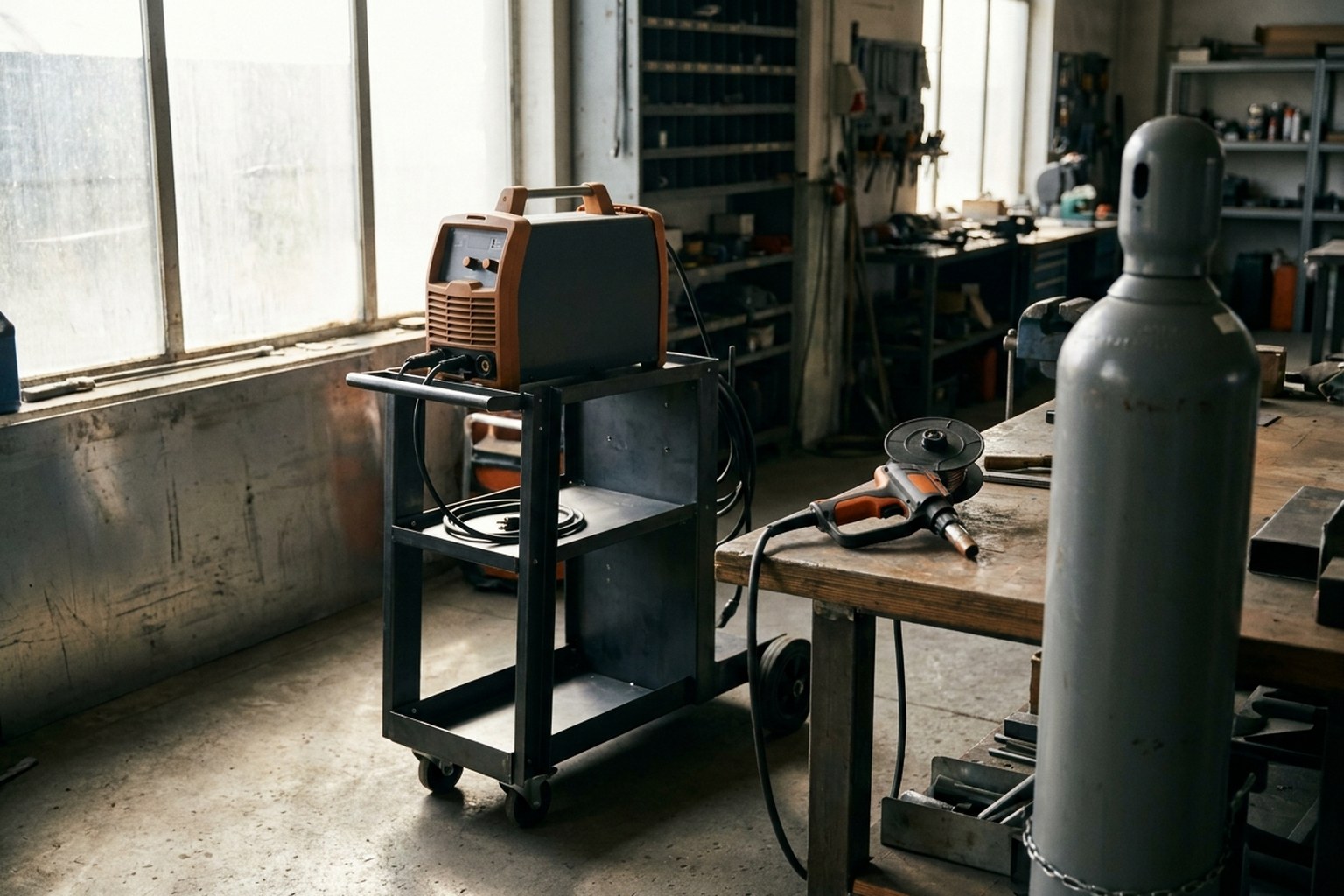
Miller’s guidance on choosing a spool gun starts with compatibility: “understand what spool guns are compatible with your welder,” because spool guns “are sized to match the performance of the welders they are aligned with.” If several are available, pick the one whose rating and duty cycle match your use. On a multiprocess listing, the practical question is whether the exact model names a spool gun connection and whether the gun is included or sold separately; our consumables and compatibility guide explains why model-specific wording matters.
| Spool gun | Aluminum wire diameter | Rated duty cycle | Matching welder named by Miller |
|---|---|---|---|
| Spoolmate 100 | .030 or .035 in | 135 A @ 30% | Millermatic 142 |
| Spoolmate 150 | .030 or .035 in | 150 A @ 60% | Millermatic 142 |
| Spoolmate 200 | .030 or .035 in | 160 A @ 60% | Multimatic 235 |
| Spoolmatic 15A / 30A | .030 to 1/16 in | 200 A @ 100% | Multimatic 235 |
The table is a worked example of how a manufacturer pairs gun and machine, not a recommendation for any listing on this site. For input power, Miller states that “in general, 115V welders do not have enough power to overcome these properties and lead to poor fusion while welding.” If a machine needs a 240V receptacle you do not have, a licensed electrician should assess the circuit; 110V vs 220V welders covers how listings state input voltage.
4043 or 5356: choosing aluminum filler wire
Miller narrows MIG aluminum filler to two common choices: “there are only two real choices-4043 or 5356 filler wire.” For most do-it-yourselfers, Miller says 4043 “will work best. It is the easiest filler to weld with because it ‘burns’ slower and has silicon added to aid in puddle control.” When a stronger weld or improved corrosion resistance is needed, 5356 is the filler of choice, but it “melts considerably faster, so more skill is needed.”
| Filler | Miller’s description | Typical fit |
|---|---|---|
| 4043 | Easiest to weld; burns slower; silicon aids puddle control | Most DIY and occasional work |
| 5356 | Stronger weld, improved corrosion resistance; melts considerably faster | When strength or corrosion resistance is required |
Wire diameter follows the machine: Miller advises consulting the welding parameter chart on your machine first and says it recommends .030 or .035 in. aluminum wire for most projects around the home. It also warns not to open a new package of aluminum wire until you are ready to use it, because the wire oxidizes and can cause an erratic arc and feeding trouble.
Cleaning and preparation are not optional
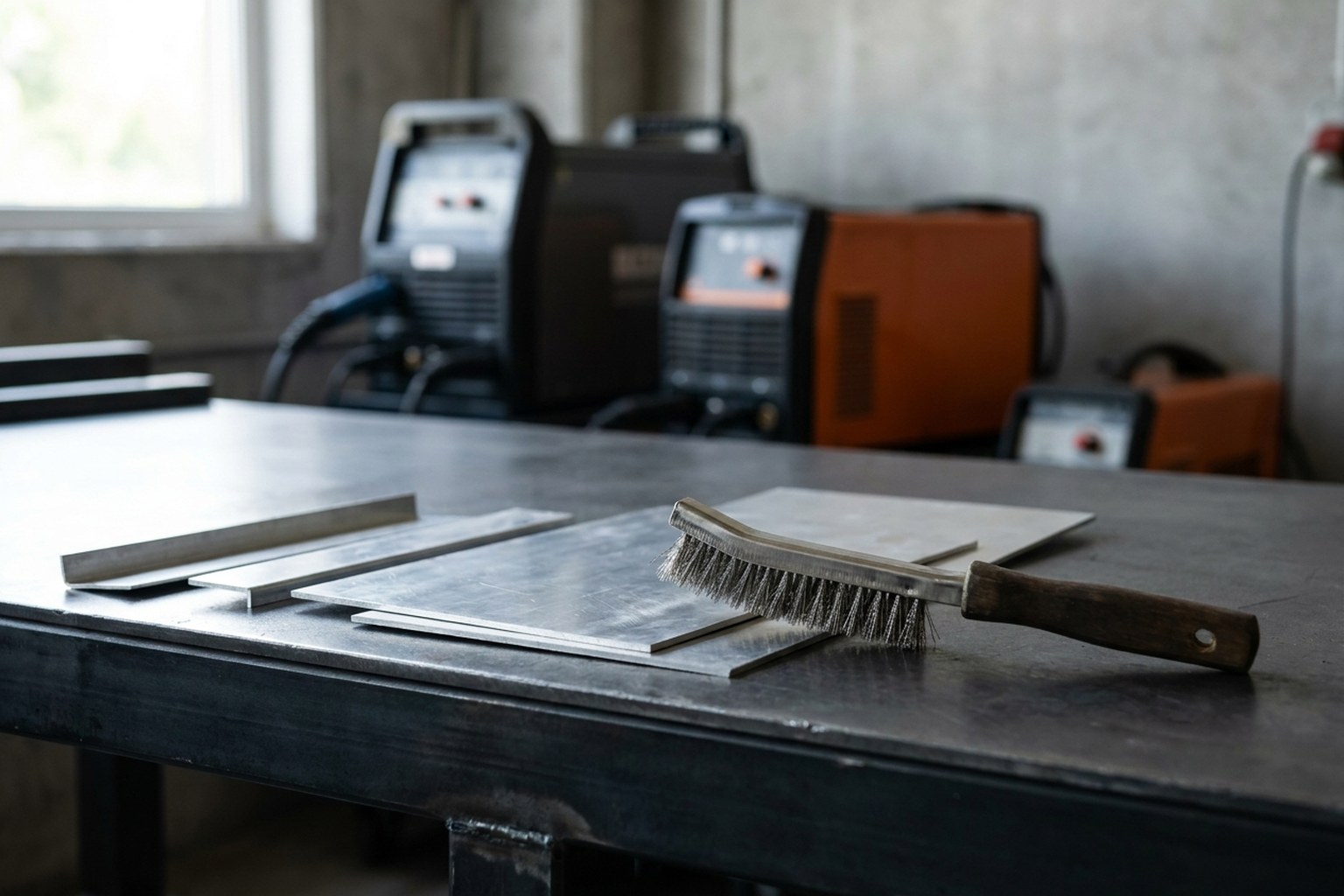
“Aluminum is particularly intolerant of any surface contamination,” Miller writes. Its recommended sequence is to remove oily contamination with a degreaser, scrub the joint with a dedicated stainless steel wire brush, then wipe off the oxide dust before welding. A brush reserved for aluminum avoids carrying steel contamination onto the joint.
- Degrease first: oily residue is removed before brushing (Miller).
- Dedicated stainless brush: used only on aluminum (Miller).
- Wipe the dust: remove oxide dust created by brushing (Miller).
- Fresh wire: keep spools sealed until use to limit oxidation (Miller).
Miller’s article includes trial settings for specific machines and thicknesses. Those numbers belong to that machine and wire; start from the chart inside your own machine’s cover and the owner’s manual rather than copying another setup.
MIG or AC TIG for aluminum: how to decide before buying
Miller’s first-welder guide describes TIG as “most commonly used to join thin sections of alloy steel, stainless steel, and nonferrous metals such as aluminum,” with greater arc control, while noting it is “comparatively more complex and difficult to master than other processes and is significantly slower.” A spool-gun MIG setup suits occasional aluminum repairs and fabrication when the machine supports it; AC TIG suits thin, appearance-critical aluminum work for someone willing to practice.
- Mostly steel, some aluminum: a multiprocess machine whose exact listing names spool gun support; compare on the best multiprocess welders ranking.
- Thin aluminum, precise beads: an AC/DC TIG machine; see the AC/DC TIG ranking and what an AC TIG listing must state.
- Unsure about duty cycle: read welder duty cycle explained before comparing amperage claims.
Whatever the route, safety requirements do not change with the metal: helmet shade, ventilation and fire prevention are covered in welding machine safety and PPE basics. This is buyer and orientation information, not an operating procedure: read the owner’s manual of the exact machine, follow ANSI Z49.1 and get hands-on instruction before striking an arc.
Sources and further reading
- Miller Electric: MIG Aluminum DIY — Selecting the Right Welder, Spool Gun and Filler Wire
- Miller Electric: How to MIG Weld Aluminum with a Spool Gun (Ron Covell)
- Miller Electric: Buying Your First Welder — A Practical Guide for Do-It-Yourselfers
- ANSI Z49.1:2021 Safety in Welding, Cutting, and Allied Processes (AWS free download, PDF)